I don't suppose there are many of my stateside brethren who are currently unaware that the US is going through yet another Presidential cycle. It seems every time you turn on the telly you are confronted with some aging patrician with politician's hair and smile and an indistinct air of oiliness about the way his shirt sleeves are rolled up. Sometimes you even get more than one of them on the screen at the same time, and I begin to weep and dry-heave for America.
In the midst of writing my brother a wandering email-almost-epistle yesterday, I had occasion to ask myself the question, "What are the issues that are most important to me?" And, oddly enough, "Domestic Security" didn't even come up. I didn't realize it till just this instant, but it's true - the main issue that is currently cornerstoning every Republican's platform never even entered my mind. Well, I suppose that just shows why I will never be president.
In fact, my whole list is replete with examples of why I will never be president. Frankly, almost everything on the list is horridly America-Second. I am an America-Seconder! Does such a designation exist? I must go check . . .
OK, not so surprisingly, the America First Party has been reborn, and surprisingly, I half agree with one-quarter of what they say. However the America-Second designation doesn't exist at all. The closest thing is America's Second Harvest, a nationwide foodbank. So now that I have finally found my true political designation, what are the philosophical underpinnings to this one-man movement?
Basically, the belief that the already best-fed can go to the back of the line for the buffet, and wait till others are served. Primarily, it is my belief that the already richest and most powerful nation should not place economic growth as the primary consideration for making larger decisions. It is not necessary that we, the rich, continue to grow richer at the expense of taking action on other issues.
Secondly, that power, true power, is only partially derived from having the biggest guns. When we see a large, overly-muscled policeman humbly doing his job, and assisting small children with finding their mommies, we feel a natural surge of goodwill toward those who protect the weak, care for the insignificant and small, and seek the good of others; how much more so when it is a person who could by right of force be overbearing and insufferable without fear of consequence? Yet when the same fellow swaggers, and appears to glory in his strength, his untouchability, and shows even the slightest disregard for the well-being others, we naturally detest him, and wish to resist him, for we see two of the most dangerous traits of humanity combined in one entity: selfishness, and a desire for power.
To those who say that they wish to restore American greatness, and American primacy, I say this - you can spend all the time you want trying to herd cats with a stick, and they still won't listen. But strap a sausage to your ass and start walking toward the milk dish, and every single one of them will follow you. When the rest of the world, (and there are some who are just too culturally blinded to see it even when it is true) sees that America is leading toward a better future for all, most will listen, and most will follow, more whole-heartedly and with less effort on our part, because they perceive that we seek a greater good.
I fully recognize that this sea change will not be immediately evident, that not all nations will be able to perceive this, or believe it, and that the great majority will continue to seek their own good as a primary goal. Be that as it may - the difference between a tycoon and a leader is the tycoon seeks his own good by whatever means are available, and the leader seeks the good of those who are led, often at personal cost to himself, by operating according to deeply held values. I leave it to you which word you would rather see applied to our country.
For the truth is this - as travel, exchange of information and transaction of commerce occur between ever further removed points around our world, we will find the common good ever more important. What issue affected only a region, a nation, or even a continent before, now comes to affect all of us, as everything from trade goods to market volitility to infestations and infectious diseases spread more quickly and widely than ever before. Whole labor forces move across borders en masse these days, bring with them the power of their sweat and the problems of their own country. Interdependence is the inescapable future, and the nation that recognises this and leads the way toward a more healthy interdependence will be the global leader, and will, on some level, earn the respect and admiration of those it assisted and led.
And that will constitute a greater power.
Saturday, September 1, 2007


Wednesday, August 22, 2007
Max
I have been more than fortunate in my life. I am, in fact, one of the most fortunate of men on our entire planet. I am exceedingly wealthy in friends.
Which is not to say I have that many. The contrary statement could well be true. I have only a few. Yet those I have are friends exhibiting qualities by which the word itself ought to be defined. Among this small number I count Max, and his wife Maria.
This post is about Max. It has a specific purpose, intent and aim. It is, (and I am not bothered to say it) intended to prompt Max to continue writing. The aim, intent and purpose of this posting is to inspire not guilt, but inspiration. By addressing here the role Max has played in my life, I hope to prompt, persuade, prod, propel and provoke Max into writing again.
You see, Max has achieved what few others could ever lay claim to - Max has created a community, in his own name. Without intention of ever doing so, Max has brought together people on different sides of our world, by sheer interest in his words - in the words he has written.
Max writes (normally) everyday. Nonsense shit, often. Pointless but interesting shit, frequently. And not so occasionally, true gems. Things that make the whole internet sit up, stop fondling its own balls, and pay attention. Suddenly, because of something Max said, people's inboxes fill up with mail from unknown and nevertheless welcome quarters, because we are discussing something that Max said. And underlying the whole conversation, often between strangers, is the idea that "you must be a half-way decent person, if Max is your friend, (despite the fact that you sound like an idiot..)" And oddly enough, the theory seems to hold true.
Max has thus created around himself, by investing nothing more than 10 minutes a day, an online community. A group of people who, if they met each other for the first time, would know a lot about the other already, simply by virtue of having discussed the ideas that Max leaves us with. Thus, technology combined with brilliance and persistence has made, or re-made in a new form, that most basic of human necessities - a community.
I met Max my first year of college - an impressionable year by any standard. Max was an unmoving beacon of stability even then; he was a rock, upon which events and turmoil (of which there would be plenty,) smashed and spent their energies.
We spent much of the first semester of our acquaintance discussing literature, and by the end of the first month of our acquaintance, had established a deep and lasting respect for each other. One of the first things I noticed about Max was the quality of his friends. I can assume he noticed the same about me, as my friends and roommates of that period were, and are, people of the highest caliber. Max and I spent afternoons sitting in fields discussing literature, liquor and love, (to steal a phrase from him, "the quivering relations between man and woman.") Which was appropriate as Max was getting married that summer.
I came to recognise a quality of thoughtfulness, a premeditated air to all that he did. Max was no fly-by-nighter. Max spent time deciding what he wanted, where his effort would be spent, and then moved with conscious steps in that direction. His solidity of character was to serve as an anchor to my own life later.
The second year of our acquaintance, Max made his home in a truck-stop. He came to have his own table in the greasy-spoon cum-drunkard hangout which masqueraded intermittently as a business enterprise under the name Stateline Cafe. He would stay at his table, drinking coffee (50 cents, at that point, bought you all you could drink for as long as you could stay,) for 24 hours at a time. He achieved a grudging respect from the toothless waitstaff, and the hapless owner, who would even tolerate his books and such remaining on the table when he had to leave for class, from whence he would return immediately thereafter. I do not recall if Max ever received flying jelly-packets to the head, with the salutation "Hey, college-boy!" (as I did,) at 2:00 in the morning, but if he did, no doubt he handled it with dignity and aplomb.
Because that was what characterised Max. Max was steady, steadfast, sure, with temerity, poise, firmness and a presence of person that could put many global leaders to shame. If I had to, I would compare Max with Chirac. Always talking, always sincere, and always sounding suspiciously as though he knows you know he is right, if you would have just taken the time to listen earlier.
This precise quality is what has allowed Max to beget "the intangible extasy of Maxness," a concept that has yet to take the world by storm, but will probably end up becoming the intellectual forebear of a great philosophical movement someday, on par with the "Chicken soup for (insert your demographic name here)" series of books.
The intangible extasy of Maxness is less complicated than many of the worlds leading paradigm-arrangement systems. It has as its underlying belief something we can all comprehend and admit into the realm of possiblity - that inside Max there is a small man, called the Ego-man. He is probably round in shape, and broadcasts a general air of vague sketchiness about his character, the kind of fellow you wouldn't want to turn your back on, for suspicion he would be found either smearing your wife's chest with chocolate and bad intent, or cleaning the last scrap of meat off your chihuahua's bones by the time you turned back round again. (Were it not for the total absorption he showed in his current task, which precludes all else.) He is clad in nothing more than a loincloth, red body paint, and abundant chesthair. Said fellow has all the self-conciousness restraint of a mongoose in a chicken coop, and spends his whole day beating out interesting rythms on his drum.
And while he beats his drum, and admires his own chesthair clumped with paint, he dances a little dance, and chants a big chant. And he chants :
Max is Great.
Fuckin Great.
Yah, yup, yum and yahoo.
Great fuckin Max.
Max eats a cheesburger
cuz its fuckin great
Max read his book
cuz its fuckin great.
Great, great, great,
Max is great.
And then he goes on to sing the cigarette song, followed by the coffee song, the Maria song, the family song, the work song, and then he sings an antihistab song, and then he starts again, with minor variations on the theme.
And the fact is, if you sit around Max for too long, you begin to hear the song, too. And you start to sing along. But you don't realise it until he gets up to go to the loo, at which point you have that odd feeling that you are singing a song that has left the room. And then you understand.
Thursday, August 16, 2007
I ain't overjoyed

In retrospect, this realization, like many, has been a long time in coming. It is always that way, at least for me. Once I realize something, I also suddenly realize that I have in fact known this for some time now, the only difference being that it has finally become so damn painfully apparent that a retarded monkey under heavy sedation in a sensory-deprivation chamber would have taken notice by now.
This flash of insight came, just like its predecessors, in a moment when my emotions were on the more extreme end of my emotional spectrum. I was walking along, pushing a bicycle whose mere sight I have come to loathe, and trying to make up lame anti-bicycle jokes.
Q: "Why did God give bicyclists hands?"
A: "It'd be pretty difficult to push your bicycle home without 'em!"
This was the 2nd time this bicycle had been out of the house in about 2 months. During the majority of those 2 months, it was languishing with a flat tire which I used as an excuse to avoid having to use the damn thing. When I finally got it fixed, and back out the door, now it had another flat, leaving me stranded about an hour and a half's walk from home.
So as I walked my stupid walk, and joked my stupid jokes, I had plenty of time to notice the crappy architecture of the buildings I walked past, and the shabbiness of many of the stores, whose bald and paint-skin chipped mannequins clustered in faux conversation outside dusty-windowed stores. I noticed that what few buildings didn't look as though the designer nursed a grudge against humanity had their plaster falling off in large chunks, revealing the brickwork underneath. And everywhere, all the buildings are coated in a coal-smoke residue that could pass for the color of dirty dark concrete, were it not for the streaks under the windows on either side, where the water washed off the sills, and left cleaner streaks to stand out.
The sidewalks are all made of individual concrete paving stones, frequently broken, pushing up out of the ground at odd angles, grass growing up between the blocks. My useless pointless fucking bike bounces and rocks over the jutting, angled blocks, and I curse boredly to myself.
All the while the cars go by, the sun shines down like something I haven't seen since a past life (which is not so far off, in case you were wondering,) the birds and bugs squawk and screech, and life is generally pleasant, considering. Then suddenly it occurs to me. This general pleasantness in outdoor life, this hideous lack of consideration for they eyes of passer-bys on the part of any architects, this small, humming, inbred small-town self-satisfaction - WHERE HAVE I SEEN IT BEFORE? And the answer comes to me - Hesston, Kansas.
Now, if your life has seen anything signficant happen during the last 9 years, this may be an indication that you are unfamiliar with this particular metropolis, so allow me to help you. The wikipedia entry for Hesston, Kansas, which has no pictures whatsoever, (due to the fact that there is nothing there worth taking pictures of except 2 girls who have been raised on nothing but corn and milk, and there are other websites for that sort of thing,) states that the population in 2000 was 3,509. And since credible research has demonstrated that the median IQ is indeed rising, we can assume that the population of Hesston has probably declined since 2000, since no person with the braincells necessary to steal candy from a person in a semi-vegetative state would remain in Hesston. I know this because I had a friend who lived his life in a highly functional semi-vegetative state, and even he left Hesston.
Nowy Sacz reminds me of Hesston. How can this be? How can a town of more than 100,000 remind me so much of a town of 3,500? Well, I suppose it is due largely to the magical, reality-bending forcefield which seems to be present in most small towns, which make them all resemble one another. But that aside, let's try to reason it out.
Is it the physical town itself? Well, yes and no. I mean, the buildings are in a dreadful state of disrepair - no doubt about it. Whereas Hesston was, on the whole, very well kempt. But Nowy Sacz is improving everyday, and slowly becoming a cleaner, nicer, less gray place to live, which is encouraging to see. When I first arrived here, I puzzled long and hard over the buildings that were
 painted on one or two or three sides, with the other side(s) left concrete gray. I pondered - had they run out of paint? Was paint truly that expensive, that the building had to be painted in stages? (This was not such an unreasonable assumption, as you could see many houses that had obviously been built in stages with the material available at that time.) It was only over the summer that I saw workmen erect scaffolding, and apply six-inch blocks of styrofoam all around the building, and then cover it in a light layer of mud, and paint it that I realized . . . they were insulating and painting at the same time. And the combined cost was indeed too much, so they were doing the buildings in stages, improving the heat retention and the appearance, one side at a time. Nowy Sacz, after the long, dark night of communism, is indeed on the mend. But it still has a long way to go.
Is it the variety of things to do, the limited offerings of entertainment in this small town? Well, that certainly may have something to do with it. I would hesitate to leap upon it as the definitive answer, since there is an occasional movie we can see here in English or Spanish, and there are a sprinkling of restaurants, of the Chinese, Polish, Pizza and Kebab variety, from which we can choose. But that gastrological cornucopia aside, (please note ironic tone) the fact remains that the streets are quite still by 9:30, and the nightlife here consists mainly of sitting in chairs around a candle in the center of the table, and listening to your friend tell a story quite similar, but different in some details, than the one he told you last week.
Is it the people? Well, yes and no. I mean, the people in Hesston were dreadfully closed off. If you hadn't grown up there, and molested the same cattle as them, well, you just weren't family. We could communicate in the same language, but there was still a barrier between us.
People in Nowy Sacz are far more open to outsiders than Hesstonites. At least the one's I deal with are far more intelligent in general, and open to outside influences, than their counterparts in Hesston. But, at the end of the day, there is still a barrier between the great majority of them, and yourself. In large part they were bred, born, and will live and die in this town. With some exceptions, their conception of life outside of Poland is no greater than my conception of a life limited to a 400 mile radius.
Which is not to say that they aren't splendid people. The ones I've hung out with have been generous, kind, and largely polite to a fault. You certainly couldn't say the same for most Spaniards. But despite their politeness, generosity and kindness, there remains a barrier between you - that you will never truly understand them, nor they you.
So . . . Nowy Sacz reminds me of Hesston, Kansas. And the fact is, every single instant that I spent in Kansas I now regard as having been a waste of my precious, God-granted life, and thus, an offense against the Almighty himself. I wish I had not been so stubbornly tough in my youth, and insisted that "when the going gets tough, the tough get rough," and had rather stuck by the maxim, "when the going gets tough, the smart move and let the dumbasses carry on in their stead." Yet, what am I to do? Having finally realized (what has been a long time coming,) that I am definitely not overjoyed to be living here, am I going to move?
The fact is, no. The job-hunting season is largely past, and I made a commitment to this school. But if you think that is enough to keep me here, you don't know your Matt very well. The real fact is that I am here for a reason; I am on a mission, and I won't quit till I get what I want. I am getting an advanced degree, which will be one more stepping-stone on the way to my ultimate goal of getting a PhD. I always said I could do time in prison, if need be. And this is a far cry from prison, but I still feel like I am doing time. I may not be locked up, but I still ain't overjoyed.
Wednesday, August 8, 2007
Where have all the Ninjas gone?
I recall, upon returning to the U.S. in the year of our Lord, 1985, ninjas. Not any specific ninjas, mind, but ninjas galore peeking out from a million places. The world, (or central California, at least) was absolutely infested with ninjas. Turn on the telly, walk down the toy aisle, or enter the video store, and ninjas came flying feet first at you from around every corner. There were white ninjas, black ninjas, grey ninjas and red ninjas. Rambo faced off against ninjas in his cartoon, (if you were so fortunate as to catch that particular artistic marvel,) as did G.I. Joe. Cobra was about half staffed with ninjas, if memory serves. There were teenage ninjas, little kid ninjas (sometimes in groups of 3,) caucasian ninjas, black ninjas, and of course Asian ninjas. Well, Japanese ones, anyway. The burning question of whether a Chinese person could ever become a ninja never seemed to get addressed - I have to assume that the ninja schools turned away all the Chinese aspirants, telling them to "Go kung-fu yourself," or something like that. Ninjas were so ubiquitous in the mid 80's that we couldn't even confine them to one species, (witness Splinter the rat, and the Turtles,) let alone a single ethnic group or neighborhood. There were ninjas-a-plenty in Beverly Hills, if you recall. Enough so that they formed a club, and went about ninja-ing things. (I can't be more specific because I don't really know what ninjas did when not hanging from ceilings, moving incredibly stealthily, or throwing small, very sharp objects that result in instant, fantastically silent mortality. I just did a web search, though, and actually found an answer to the question -
Q: "What do ninjas do when they are not cutting off heads?"
A: "Most of their freetime is spent flying, but sometimes they stab."
I am glad we got that sorted out.
My point, however, is that something very dramatic has happened among the ninja populations over the past 20 years. Today we have far less ninjas than we used to. I attribute this to one of two things (or maybe a confluence of both factors.) First, global climate change, and secondly, the return of Pirates. I will explain in greater detail later.
Sunday, July 29, 2007
The Long Walk
I went on a walk yesterday, which turned out to be a long walk, which, though completely beside the point, is the title of a Stephen King book (which he wrote under a pseudonym) in which people compete for a prize by walking as long as possible, non-stop. If your pace sinks under x number of miles per hour, you are warned twice, then shot. And toward the end of my long walk yesterday, I was wishing someone would shoot me.
I began by walking to John's house. (On the way to John's house I saw the most fabulous VW - but anyway.) John is in this course with Cynthia, and is from Southern Arkansas. Cynthia had told me there was a fellow from AR in her course, and the instant I laid eyes on him I knew he was the Arkansan. He is painfully sincere, and a bit serious, and all in all a wonderful person. The night before we had watched a movie together with 4 other people, and John alone voted to watch "Hotel Rwanda," while everyone else opted for the "Tenacious D" movie. I think he was a little disappointed that we would choose to fill our minds with fluff and nonsense instead of watching a modern-day genocide, but frankly, I don't need a reminder to remain aware that humanity is still just as shitty as it has always been. That, and I had already seen it. Anyhoo, after the movie John asked if anyone would be interested in going to see where the Jewish ghetto of Krakow had been. I had just been reading about it earlier in the day, and so I jumped at the chance. So at 8:00 I set out from Cynthia's apartment and walked the half-hour to John's apartment.
From there we walked toward the town square, and I took pictures along the way of all the architectural oddities I saw as I went. Although it was warming up, it was still just a hair chilly, so I was glad I had brought my jacket. Past the main square we finally found a bakery that was open, and bought a couple of donuts. About 30 minutes later we had crossed the Vistula river, and made our way into the neighborhood where the ghetto used to be. We were talking rapidly, continuously about this and that, and so after about 10 minutes walking in one direction, we would note that we had somehow walked past where we wanted to be, and yet hadn't seen anything. This only happened about 3 or 4 times before we started to pay more attention.
We were looking for the remnants of the wall that the Nazis had erected around the ghetto. I had read somewhere that the wall was built in the form of Jewish gravestones. I found this fantastic on one hand (I mean, why bother?) and thoroughly believable on the other, (there are numerous instances that illustrate how the Nazis really went out of their way to lend a personalised touch to the suffering they dispensed; so if true, it would really be just one more example of their great attention to detail which probably assures they will be the interior decorators of Hell.) John, on the other hand, had heard that it was built FROM Jewish gravestones, which seemed similarly fantastic, with a nice touch of profaning-the-sacred / macabre. I couldn't wait to find out.
We were taking our fifth pass through the area when John finally noted the map said the wall was located "behind the school." Oh. No wonder we didn't see it. Sure enough, there was a school, and after some discussion of how we were going to get over the fence, we noticed the gate was left open, so we went through.

Behind the school was the children's playground, hedged in by a cliff-face on one end, into which ran a large grey wall, in the shape of headstones. Sho-nuff. That was it. Visually unimpressive on its own, it was nevertheless a daunting sight when you stop to consider it was erected in order to contain people who, like cattle, would later be led to slaughter. The old man's-inhumanity-to-man bit is certainly getting old, and should by now be considered just one more of the characteristic oddities inherent to the human species. But all that aside, it was interesting to ponder.
Especially given the juxtaposition with the children's playground, I couldn't help but try and imagine what different view on history they would have, growing up playing quite literally in the shadow of the holocaust. Would this make history more real, more alive, more a part of your reality, or less, and somehow diminished by its day-to-day hum-drum presence in your life? Someone once spoke of the banality of evil, and I can think of no greater example - an erection of clay, stone, mortar, designed to facilitate the murder of thousands, which now stands innocently sheltering children in the playground, with no real mark left by its former use.
From there we walked to the factory rented and run by Oskar Schindler, of Schindler's list fame.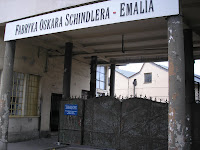 The sign still hangs over the gate, and for a small price you can go inside. John wasn't interested, as he wanted to get on to doing other things, but once again it was interesting to see a spot in history which had now become a spot in film history as well. Incidentally, though the movie seems to portray Schindler as becoming less of a womaniser, and growing a conscience, to the point of practically becoming a full on bhodisatva by the end of the movie, he seems to have kept his flaws intact to the end. A bit of reading reveals that despite having no money, he continued to spend profligately, living off donations from the Jews he had saved, staying in nice hotels, gambling and maintaining expensive girlfriends, frequently running out of money before asking those he saved for some more. But that said, the fact remains that he spent all he made during the war on saving people's lives, in the face of great personal danger, and as such deserves to be remembered as righteous.
After this we went to a coffee shop that John had heard of, which supposedly roasted and ground their own coffee. I suppose this makes them the equivalent of a micro-brewery, but with coffee instead of beer. I had a cappuccino and John had something called "spinach cake" which turned out to be a lovely, flaky, spinach-containing pastry, which they had liberally doused in ketchup. John was duly horrified, having never seen imagined such barbarism could exist. I had to laugh, as I had seen this sort of tragedy occur with pizza, but hadn't imagined the practice could also be applied to pastries.
Following our coffee, we went in search of the mound under which the original "King Krak" was buried - for whom Krakow is named. After some walking in a generally upwards direction, we saw an old brick fortification, and an old, tiny chapel. John wandered off to try and locate this mound, while I wandered off to see the tiny chapel. It was locked, but after wandering behind the chapel, it appeared that there was a way through the fence around the old fortification. So in I went.
It turned out that I was not inside the fence now, but rather running between two fences, and shuffling along a path that was overhung by trees, overgrown with weeds, and over-littered with bottles. Walking further along I came to a large hole in the fence, which led into some brambles and trees next to the fortification.
I called John on his mobile phone, and it turned out he was right behind me. He didn't want to go in, so I went in alone. I little ways in I started hearing voices, and it turned out there were three people in there, doing some sort of caretaking, which today consisted of using a small hatchet to chop down a tree growing too close to the fortifications. I worked my way back out to John, and we wandered around the edge of the fence, and at a certain point were able to clearly see what they were doing inside, and laughed that they had nothing more than a hatchet to attack this tree with.
After much ducking and shuffling we emerged on the top of a huge cliff, and looked down to see a children's playground. The whole scene looked vaguely familiar, and we suddenly realised that we were now on top of the cliff which had the fragment of the ghetto wall at the bottom. Without realising it, we had made a full circle, and come back to where we started, albeit 30 metres higher.
After a bit more bush-whacking, (we ran through some stinging nettles) we saw the mound off in the distance. It was difficult to see how to get their via the roads, as there was a large, fenced highway between us and it, but a path through the trees and nettles and underbrush led off in that direction, so we took it.
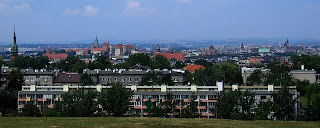
Within about 5 minutes the path dropped us down in front of a bridge which led over the highway, and toward the mound. After a bit more hiking up a large hill, we finally came to the base of the mound, and went up, up, up the steep side. The view from the top was amazing, as I had never realised that Krakow had so many outlying areas. We were, by all rights, on the outside of Krakow proper, but the suburbs and high-rise communist blocks of flats continued for a long ways further out. We could see the church in the main square, where we had started out, and the distance between various famous buildings.
Then we headed back. It was a long walk back, and once we got back to the main square, it was 1:30, and after watching a break-dancing exhibition, John went home to begin his coursework for tomorrow. I stayed, and meandered in and out of shops, perusing guidebooks of Krakow, and noting the angle from which they photographed various landmarks, making mental notes to try the same myself. Cynthia called and asked me to find a cassette tape for her - I had not bought a cassette tape in the last 15 years, I think, so it was a novel experience. Then I went back into the main square, and tried again to capture what has always eluded me - the beauty of the cathedral in the main square.
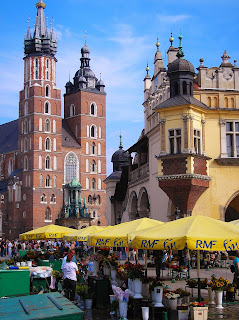
The two towers of the cathedral are of differing heights, but that is not exceptional in Poland. I have never seen it anywhere else, but here there are plenty of churches whose two front towers are different heights, and done in differing styles. But the one in Krakow has a story behind it. The two towers were built by two brothers, both architects. The younger wanted to go faster, and further, and so outstripped his brother, but due to lack of planning, had to build narrower and narrower as the height increased. At some point the towers became a towering point of contention between the two (sorry, couldn't resist,) and one brother stabbed the other one to death. Oddly enough, though, no one agrees on which brother killed which. Some say the brother who built the taller tower killed the other to keep him from surpassing his. Others say the brother who built the shorter tower killed the other out of jealousy. Some stories report the murdering brother then comitted suicide, while others report he was executed. Either way, they have a knife hanging on the wall in the cloth hall, which is undoubtedly the very implement used by whichever brother for whatever reason before ending up however he did.
The cloth hall itself is a beautiful covered passageway, with shops down each side, and with a line of back-to-back stalls down part of the middle. In here they sell wood carvings, chess sets, amber jewelery, beads, toys, reproduction swords, polish-folk dresses, and any object that can be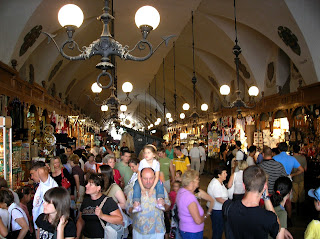 inscribed with the Polish flag. All along the upper portion of the curved walls run windows that let in daylight, and between them are painted the coats of arms of various cities. In two side-by-side rows down the center run hanging lights. The overall effect is quite pleasing, and makes a tired tourist stop and think - "Now this is exactly the kind of place that would be the perfect to get my wallet stolen in."
They say upstairs is a great gallery, but it has been closed for renovation for the past year, so maybe someday I will get to see it. In the meantime, I content myself with trying to take photos of it that are of guidebook quality, and enjoy the jostling and bumping and waiting for someone to pick my pocket.
 which, though completely beside the point, is the title of a Stephen King book (which he wrote under a pseudonym) in which people compete for a prize by walking as long as possible, non-stop. If your pace sinks under x number of miles per hour, you are warned twice, then shot. And toward the end of my long walk yesterday, I was wishing someone would shoot me.
I began by walking to John's house. (On the way to John's house I saw the most fabulous VW - but anyway.) John is in this course with Cynthia, and is from Southern Arkansas. Cynthia had told me there was a fellow from AR in her course, and the instant I laid eyes on him I knew he was the Arkansan. He is painfully sincere, and a bit serious, and all in all a wonderful person. The night before we had watched a movie together with 4 other people, and John alone voted to watch "Hotel Rwanda," while everyone else opted for the "Tenacious D" movie. I think he was a little disappointed that we would choose to fill our minds with fluff and nonsense instead of watching a modern-day genocide, but frankly, I don't need a reminder to remain aware that humanity is still just as shitty as it has always been. That, and I had already seen it. Anyhoo, after the movie John asked if anyone would be interested in going to see where the Jewish ghetto of Krakow had been. I had just been reading about it earlier in the day, and so I jumped at the chance. So at 8:00 I set out from Cynthia's apartment and walked the half-hour to John's apartment.
From there we walked toward the town square, and I took pictures along the way of all the architectural oddities I saw as I went. Although it was warming up, it was still just a hair chilly, so I was glad I had brought my jacket. Past the main square we finally found a bakery that was open, and bought a couple of donuts. About 30 minutes later we had crossed the Vistula river, and made our way into the neighborhood where the ghetto used to be. We were talking rapidly, continuously about this and that, and so after about 10 minutes walking in one direction, we would note that we had somehow walked past where we wanted to be, and yet hadn't seen anything. This only happened about 3 or 4 times before we started to pay more attention.
We were looking for the remnants of the wall that the Nazis had erected around the ghetto. I had read somewhere that the wall was built in the form of Jewish gravestones. I found this fantastic on one hand (I mean, why bother?) and thoroughly believable on the other, (there are numerous instances that illustrate how the Nazis really went out of their way to lend a personalised touch to the suffering they dispensed; so if true, it would really be just one more example of their great attention to detail which probably assures they will be the interior decorators of Hell.) John, on the other hand, had heard that it was built FROM Jewish gravestones, which seemed similarly fantastic, with a nice touch of profaning-the-sacred / macabre. I couldn't wait to find out.
We were taking our fifth pass through the area when John finally noted the map said the wall was located "behind the school." Oh. No wonder we didn't see it. Sure enough, there was a school, and after some discussion of how we were going to get over the fence, we noticed the gate was left open, so we went through.

Behind the school was the children's playground, hedged in by a cliff-face on one end, into which ran a large grey wall, in the shape of headstones. Sho-nuff. That was it. Visually unimpressive on its own, it was nevertheless a daunting sight when you stop to consider it was erected in order to contain people who, like cattle, would later be led to slaughter. The old man's-inhumanity-to-man bit is certainly getting old, and should by now be considered just one more of the characteristic oddities inherent to the human species. But all that aside, it was interesting to ponder.
Especially given the juxtaposition with the children's playground, I couldn't help but try and imagine what different view on history they would have, growing up playing quite literally in the shadow of the holocaust. Would this make history more real, more alive, more a part of your reality, or less, and somehow diminished by its day-to-day hum-drum presence in your life? Someone once spoke of the banality of evil, and I can think of no greater example - an erection of clay, stone, mortar, designed to facilitate the murder of thousands, which now stands innocently sheltering children in the playground, with no real mark left by its former use.
From there we walked to the factory rented and run by Oskar Schindler, of Schindler's list fame.
 The sign still hangs over the gate, and for a small price you can go inside. John wasn't interested, as he wanted to get on to doing other things, but once again it was interesting to see a spot in history which had now become a spot in film history as well. Incidentally, though the movie seems to portray Schindler as becoming less of a womaniser, and growing a conscience, to the point of practically becoming a full on bhodisatva by the end of the movie, he seems to have kept his flaws intact to the end. A bit of reading reveals that despite having no money, he continued to spend profligately, living off donations from the Jews he had saved, staying in nice hotels, gambling and maintaining expensive girlfriends, frequently running out of money before asking those he saved for some more. But that said, the fact remains that he spent all he made during the war on saving people's lives, in the face of great personal danger, and as such deserves to be remembered as righteous.
After this we went to a coffee shop that John had heard of, which supposedly roasted and ground their own coffee. I suppose this makes them the equivalent of a micro-brewery, but with coffee instead of beer. I had a cappuccino and John had something called "spinach cake" which turned out to be a lovely, flaky, spinach-containing pastry, which they had liberally doused in ketchup. John was duly horrified, having never seen imagined such barbarism could exist. I had to laugh, as I had seen this sort of tragedy occur with pizza, but hadn't imagined the practice could also be applied to pastries.
Following our coffee, we went in search of the mound under which the original "King Krak" was buried - for whom Krakow is named. After some walking in a generally upwards direction, we saw an old brick fortification, and an old, tiny chapel. John wandered off to try and locate this mound, while I wandered off to see the tiny chapel. It was locked, but after wandering behind the chapel, it appeared that there was a way through the fence around the old fortification. So in I went.
It turned out that I was not inside the fence now, but rather running between two fences, and shuffling along a path that was overhung by trees, overgrown with weeds, and over-littered with bottles. Walking further along I came to a large hole in the fence, which led into some brambles and trees next to the fortification.
I called John on his mobile phone, and it turned out he was right behind me. He didn't want to go in, so I went in alone. I little ways in I started hearing voices, and it turned out there were three people in there, doing some sort of caretaking, which today consisted of using a small hatchet to chop down a tree growing too close to the fortifications. I worked my way back out to John, and we wandered around the edge of the fence, and at a certain point were able to clearly see what they were doing inside, and laughed that they had nothing more than a hatchet to attack this tree with.
After much ducking and shuffling we emerged on the top of a huge cliff, and looked down to see a children's playground. The whole scene looked vaguely familiar, and we suddenly realised that we were now on top of the cliff which had the fragment of the ghetto wall at the bottom. Without realising it, we had made a full circle, and come back to where we started, albeit 30 metres higher.
After a bit more bush-whacking, (we ran through some stinging nettles) we saw the mound off in the distance. It was difficult to see how to get their via the roads, as there was a large, fenced highway between us and it, but a path through the trees and nettles and underbrush led off in that direction, so we took it.
Within about 5 minutes the path dropped us down in front of a bridge which led over the highway, and toward the mound. After a bit more hiking up a large hill, we finally came to the base of the mound, and went up, up, up the steep side. The view from the top was amazing, as I had never realised that Krakow had so many outlying areas. We were, by all rights, on the outside of Krakow proper, but the suburbs and high-rise communist blocks of flats continued for a long ways further out. We could see the church in the main square, where we had started out, and the distance between various famous buildings.

Then we headed back. It was a long walk back, and once we got back to the main square, it was 1:30, and after watching a break-dancing exhibition, John went home to begin his coursework for tomorrow. I stayed, and meandered in and out of shops, perusing guidebooks of Krakow, and noting the angle from which they photographed various landmarks, making mental notes to try the same myself. Cynthia called and asked me to find a cassette tape for her - I had not bought a cassette tape in the last 15 years, I think, so it was a novel experience. Then I went back into the main square, and tried again to capture what has always eluded me - the beauty of the cathedral in the main square.

The two towers of the cathedral are of differing heights, but that is not exceptional in Poland. I have never seen it anywhere else, but here there are plenty of churches whose two front towers are different heights, and done in differing styles. But the one in Krakow has a story behind it. The two towers were built by two brothers, both architects. The younger wanted to go faster, and further, and so outstripped his brother, but due to lack of planning, had to build narrower and narrower as the height increased. At some point the towers became a towering point of contention between the two (sorry, couldn't resist,) and one brother stabbed the other one to death. Oddly enough, though, no one agrees on which brother killed which. Some say the brother who built the taller tower killed the other to keep him from surpassing his. Others say the brother who built the shorter tower killed the other out of jealousy. Some stories report the murdering brother then comitted suicide, while others report he was executed. Either way, they have a knife hanging on the wall in the cloth hall, which is undoubtedly the very implement used by whichever brother for whatever reason before ending up however he did.
The cloth hall itself is a beautiful covered passageway, with shops down each side, and with a line of back-to-back stalls down part of the middle. In here they sell wood carvings, chess sets, amber jewelery, beads, toys, reproduction swords, polish-folk dresses, and any object that can be
 inscribed with the Polish flag. All along the upper portion of the curved walls run windows that let in daylight, and between them are painted the coats of arms of various cities. In two side-by-side rows down the center run hanging lights. The overall effect is quite pleasing, and makes a tired tourist stop and think - "Now this is exactly the kind of place that would be the perfect to get my wallet stolen in."
They say upstairs is a great gallery, but it has been closed for renovation for the past year, so maybe someday I will get to see it. In the meantime, I content myself with trying to take photos of it that are of guidebook quality, and enjoy the jostling and bumping and waiting for someone to pick my pocket.
Saturday, July 28, 2007
Slouching toward the Kleenex box, in order to blow.
What did I do in a past life to merit the misery of walking the earth with a constantly dripping nose, rubbed-red-raw from constant futile wiping and blowing, hands full of soggy tissues (which I feel obligated to re-use unless I wish to be solely responsible for the deforestation of a large portion of the world's forests,) snuffling, snorting, hacking, hocking, wiping, and blowing, and grossing out people in my vicinity?
I spent the majority of last night doing nasal-excretion-management. About 30 seconds after having blown my nose, I would begin trying to find a dry spot on one of the 4 kleenexes I was rotating through, and begin to dab, dab, dab, the accumulated moisture from the bottom of my one hyperactively productive nostril. After sufficient time had passed to allow my body to produce a sufficient amount of phlegmy fun to entirely pack and seal one nostril to the point that the accumulated weight was beginning to tip my head to the right, I would once again gracefully dab, and then rise and slouch my way to the door, to blow, to breathe, to enter once again the cycle of mucus.
Now I know, that really, my tribulations are not that great when compared with the sufferings of others. When placed next to the soul-torturing phase of personal growth that Britney Spears is currently undergoing, it makes my troubles resemble nothing more than a moist nostril. But that's the point, isn't it? Just as gas expands to fill the space of it's container, so one's trials expand to fill the mental and emotional space you currently have available to host them. So while not being ethnically cleansed, my nose is indeed significant in its ability to engender suffering. And while not yet reduced to doing commercials for the Psychic Friends Network, Britney's divorce and inability to have a single genuinely original creative concept will torture her mind no less than the destruction of a village in Darfur would weigh on the minds of its former residents. Pain is relative, you see.
So what I am proposing, while revolutionary, is quite necessary. Based on the fact that my particular private pains can have no equal, exact, corollary in your life, I propose a graduated scale of emotional torment be developed. A Moh's scale of Agony, a Richter of Recrudescence, something that would translate "my cat has a raging case of dander" into solid decibels of life-disrupting distress, which you can easily equate to your personal podalgia of "my wife leaves things on the floor and I stumble over them in the dark of night."
The result would be dramatic, and instantaneous. Until now, pain has been a private affair, something that cannot be communicated objectively, a solitary struggle that each person undertakes, knowing that no one can comprehend his personal pangs of woe. Now, though, one has only to say the number - "I am running a 9.2 on the Matt's Distress Distribution" to elicit instant moans of sympathy (true, heart-felt sympathy, as your listener, for the first time in history, can adequately comprehend the scale of your pain) from your listeners.
The results would be far-reaching. For the first time in history, two aggrieved parties could sit down on opposite sides of the negotiating table, and hope to truly understand the hurt the other suffers. "When you launch rockets at our settlements, it gives me a 7.772," the Israelis would say. The Palestinians would respond with "When you deny us the ability to cross a checkpoint to get to our jobs, it gives my whole family a 5.99 increasing by .42 with each passing day." Obviously everyone would need to bring a calculator to the table, and it might take a while to factor in all the components, but in the end whoever came out to have a greater pain index would be the long-suffering winner, hands down, and could dictate terms to the opposing party. Unless, of course, this would cause too much pain to the opposing side, in which case we would just have to re-figure. Obviously.
Thursday, July 26, 2007
Krakow
Tonight I will sleep in Krakow. This is a first for me - everyone else I know regularly stays the night in Krakow, but tonight will be my first night spent there. (Well, that isn't quite true - if you count wandering the streets till a late hour, killing time till boarding the bus to Ukraine.)
The funny thing is - I have been to and through Krakow plenty. I have stayed quite late in Krakow a couple of times, and I have arrived quite early in the morning a quite a few times. Yet somehow the thought of spending the night, (and not just one night, but three,) makes me feel all giddy with anticipation. Maybe it is the life I have right now - living in a podunk backwater that makes it so exciting. Maybe it is Krakow itself. While I have walked the town practically from end to end, it has only recently begun to give up its secrets, the charming nooks and crannies shops and legends corner stores and slimy-good restaurants that all beautiful old towns have. (On a completely irrelevant side-note, in Barcelona I drank absinthe in Hemingway's favorite bar, which probably hadn't been cleaned since he was last there, and ate Indian food in restaurants where you wouldn't want to touch the walls, got the come-hithers from the hookers and lost money injudiciously to street-scams, and never even came close to feeling that Barcelona was a charming, or even very interesting, city.)
Krakow, on the other hand, has less wicked, crackling energy than Barcelona, and more of an air of staid reserve, under which pulses a strong current of life, with all the diverse manifestations which that implies. In Krakow you are not assaulted from every side with hawkers and the nimble-fingered. Although quite crowded in places, the feeling of being hemmed in and moved with a sea of humming humanity is not so great.
When entering Krakow by bus, you first approach the river Vistula, across which you can see the old royal castle Wawel (Vahvehl,) built not so much for fortifications, (though it certainly looks imposing) but rather as a seat of royal power. The Wawel is built in a crook of the Vistula, on a hill over a cave where the dragon used to live. Obviously the dragon doesn't live there any more, since a sly shepherd-boy came up with the idea of stuffing a sheepskin with sulfur and leaving it for the dragon to eat, thus winning the hand of the princess. (How she felt about marrying a shepherd-boy based simply on his sheep-stuffing skills probably doesn't bear dwelling on.)
After travelling around the Wawel on two sides, you cross the Vistula, and drive past a number of large monolithic buildings decorated with oversized muscular workers doing very muscular-worker things, like making steel with their shirts off and hats on. (You also drive past a small, tucked-away gym and bath-house named "Spartacus," in which I receive the distinct impression that there are also a lot of muscular men with their shirts off, doing muscular men things, albeit probably not with steel, though maybe with hats, but then I wouldn't know, ahem.)
This is an area with lots of University buildings, and consequently a lot of museums. Most are art museums, and the Wawel itself has the royal armoury, which boasts all sorts of lances, swords, daggers, armor and helmets-with-spikes-on and cutlasses-with-gun-barrels-installed, for the pirate who has everything, and likes it all to fit in a single, easy-to-carry package. (I may poke fun at this particular contraption, but don't let it fool you. I desperately want one.)
As you ride through this area, you are on the street Mickiewicz, which is the name of the Polish national poet, who has a street, a school and a statue bearing his name in every town in Poland big enough to fit a street, a school and a statue, and sometimes two statues in towns not big enough to host all three simultaneously. If your town cannot afford a statue or three of Adam Mickiewicz, you needn't panic, as there are at least four different Vodkas named for his characters, so there are less expensive ways of keeping reminders of his cultural greatness around, at all hours of the day. (I keep planning on buying his most famous work, a rather large tome entitled Pan Tadeusz, and reading through it while I am here. I have always found that reading the great literary works of a country gives one a feel for the cultural sensibility that might not be accessible anywhere else.)
So wish me luck, I'm off to the big city, to spend some days and evenings looking for fun and fascinating facts and historical crannies and old coins at reasonable prices.
 Krakow, but tonight will be my first night spent there. (Well, that isn't quite true - if you count wandering the streets till a late hour, killing time till boarding the bus to Ukraine.)
The funny thing is - I have been to and through Krakow plenty. I have stayed quite late in Krakow a couple of times, and I have arrived quite early in the morning a quite a few times. Yet somehow the thought of spending the night, (and not just one night, but three,) makes me feel all giddy with anticipation. Maybe it is the life I have right now - living in a podunk backwater that makes it so exciting. Maybe it is Krakow itself. While I have walked the town practically from end to end, it has only recently begun to give up its secrets, the charming nooks and crannies shops and legends corner stores and slimy-good restaurants that all beautiful old towns have. (On a completely irrelevant side-note, in Barcelona I drank absinthe in Hemingway's favorite bar, which probably hadn't been cleaned since he was last there, and ate Indian food in restaurants where you wouldn't want to touch the walls, got the come-hithers from the hookers and lost money injudiciously to street-scams, and never even came close to feeling that Barcelona was a charming, or even very interesting, city.)
Krakow, on the other hand, has less wicked, crackling energy than Barcelona, and more of an air of staid reserve, under which pulses a strong current of life, with all the diverse manifestations which that implies. In Krakow you are not assaulted from every side with hawkers and the nimble-fingered. Although quite crowded in places, the feeling of being hemmed in and moved with a sea of humming humanity is not so great.
When entering Krakow by bus, you first approach the river Vistula, across which you can see the old royal castle Wawel (Vahvehl,) built not so much for fortifications, (though it certainly looks imposing) but rather as a seat of royal power. The Wawel is built in a crook of the Vistula, on a hill over a cave where the dragon used to live. Obviously the dragon doesn't live there any more, since a sly shepherd-boy came up with the idea of stuffing a sheepskin with sulfur and leaving it for the dragon to eat, thus winning the hand of the princess. (How she felt about marrying a shepherd-boy based simply on his sheep-stuffing skills probably doesn't bear dwelling on.)
After travelling around the Wawel on two sides, you cross the Vistula, and drive past a number of
 large monolithic buildings decorated with oversized muscular workers doing very muscular-worker things, like making steel with their shirts off and hats on. (You also drive past a small, tucked-away gym and bath-house named "Spartacus," in which I receive the distinct impression that there are also a lot of muscular men with their shirts off, doing muscular men things, albeit probably not with steel, though maybe with hats, but then I wouldn't know, ahem.)
This is an area with lots of University buildings, and consequently a lot of museums. Most are art museums, and the Wawel itself has the royal armoury, which boasts all sorts of lances, swords, daggers, armor and helmets-with-spikes-on and cutlasses-with-gun-barrels-installed, for the pirate who has everything, and likes it all to fit in a single, easy-to-carry package. (I may poke fun at this particular contraption, but don't let it fool you. I desperately want one.)
As you ride through this area, you are on the street Mickiewicz, which is the name of the Polish national poet, who has a street, a school and a statue bearing his name in every town in Poland big enough to fit a street, a school and a statue, and sometimes two statues in towns not big enough to host all three simultaneously. If your town cannot afford a statue or three of Adam Mickiewicz, you needn't panic, as there are at least four different Vodkas named for his characters, so there are less expensive ways of keeping reminders of his cultural greatness around, at all hours of the day. (I keep planning on buying his most famous work, a rather large tome entitled Pan Tadeusz, and reading through it while I am here. I have always found that reading the great literary works of a country gives one a feel for the cultural sensibility that might not be accessible anywhere else.)
So wish me luck, I'm off to the big city, to spend some days and evenings looking for fun and fascinating facts and historical crannies and old coins at reasonable prices.
Subscribe to:
Posts (Atom)